


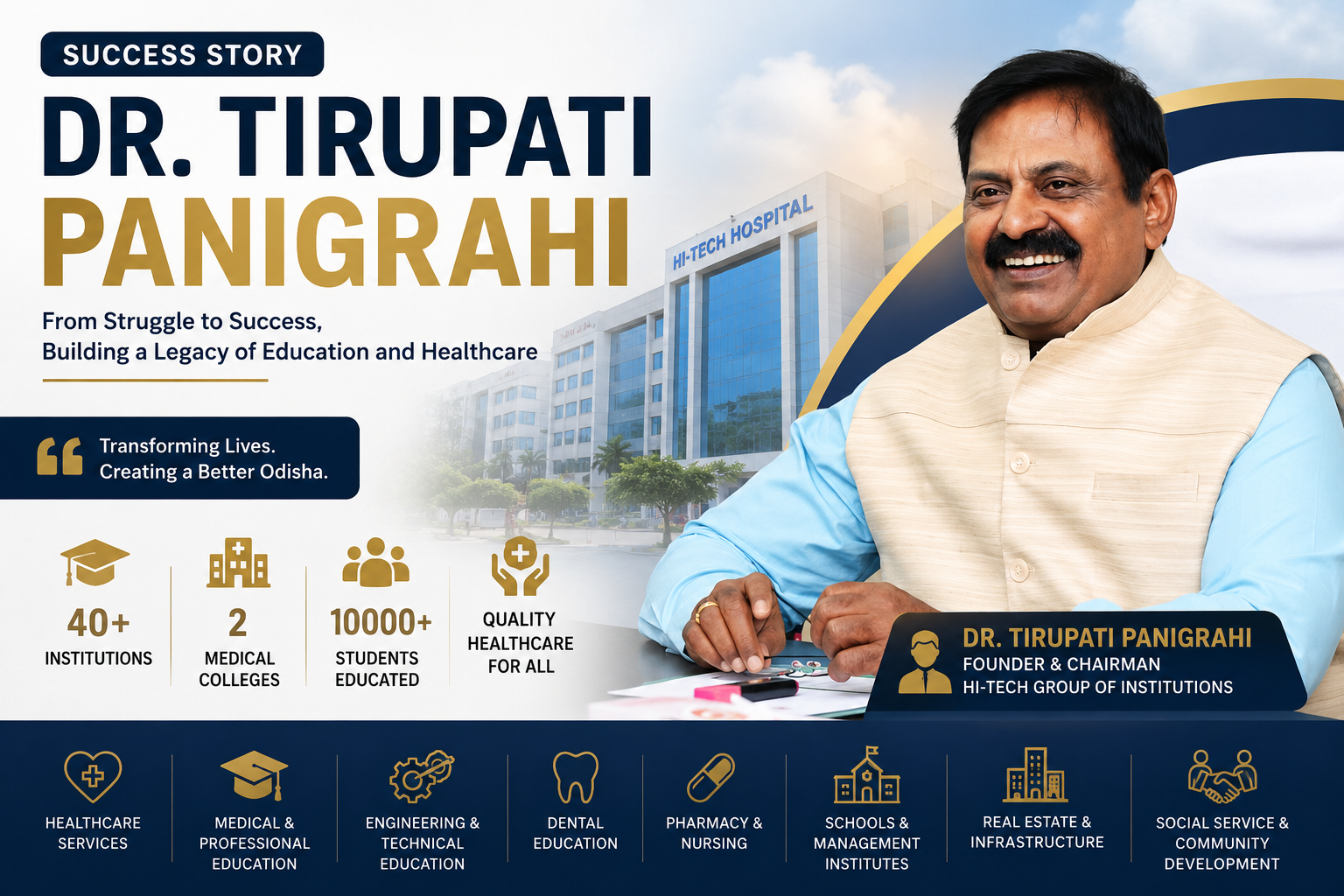

Founder & Chairman, Hi-Tech Group of Institutions
Dr. Tirupati Panigrahi’s journey is not simply a business success story. It is the story of a young boy who was denied opportunities by poverty, yet dedicated his life to creating opportunities for thousands of others.
Today, he is publicly identified as the Founder and Chairman of the Hi-Tech Group of Institutions and Chairman of Hi-Tech Medical College and Hospital. He has also served as Managing Director of Hi-Tech Estates & Promoters. Therefore, for a formal publication, the most accurate headline designation is Founder and Chairman, Hi-Tech Group of Institutions, rather than only “MD of Hi-Tech Hospital.”
A Childhood Defined by Struggle
Born into a financially struggling family, Tirupati Panigrahi experienced hardship from a very young age. According to published profiles, he had to discontinue formal education after the seventh standard because his family could not afford to continue supporting his studies.
At an age when most children were attending school and planning their futures, he was working in a small hotel. He reportedly cooked, cleaned and served customers across seven tables. At night, those same tables became his shelter.
There were periods when he bathed at railway platforms and slept beneath hotel tables. However, instead of allowing these circumstances to destroy his confidence, he treated life itself as his university.
Every difficult day taught him something: discipline, responsibility, patience, survival and the importance of dignity. Most importantly, his inability to continue his own education created a lifelong determination to ensure that poverty would not prevent other children from studying.
A Promise That Became His Life’s Mission
Dr. Panigrahi was deeply attached to his mother. His foundation’s profile states that he promised her he would support his younger siblings and one day help transform education, employment and empowerment in Odisha.
It was an extraordinary promise from someone who had very limited resources himself. Yet that promise eventually became the foundation of an extensive network of educational, healthcare and social-service institutions.
The First Step: An Educational Institution in Guma
In 1992, he reportedly established his first educational institution—a +2 college in Guma, named in honour of his mother.
The institution began with approximately 700 students, many belonging to tribal, Dalit and economically disadvantaged communities. This was more than a commercial venture. It represented his belief that quality education should reach rural and underprivileged students, not remain limited to wealthy urban families.
That single institution became the starting point of a much larger movement.
The Birth of the Hi-Tech Group
The Hi-Tech Group of Institutions formally traces its development under the T.P. Educational Trust from the 1990s. From an initial educational initiative, the organisation expanded into medical education, healthcare, engineering, dentistry, nursing, pharmacy, management, science education and schools.
The group’s own foundation profile describes a network that includes:
- Two medical colleges
- Three engineering colleges
- One dental college
- Nursing, pharmacy and physiotherapy institutions
- Management and science colleges
- Schools and several other professional institutions
Different organisational profiles use different totals—some mention 40 institutions while newer promotional profiles mention 48. Because these figures may reflect expansion or different counting methods, the safest description is that the group operates dozens of institutions across healthcare and education.
Major Institutions and Business Verticals
1. Hi-Tech Medical College and Hospital, Bhubaneswar
Established in the mid-2000s, Hi-Tech Medical College and Hospital in Bhubaneswar is promoted by the group as Odisha’s first private medical college.
The institution combines medical education with multi-speciality healthcare services. Its broader ecosystem includes teaching departments, hospital facilities, diagnostic services, emergency care and professional medical training.
The college is affiliated with the Odisha University of Health Sciences and appears in the National Medical Commission’s institutional records.
2. Hi-Tech Medical College and Hospital, Rourkela
The group extended its medical-education and healthcare presence to western Odisha through Hi-Tech Medical College and Hospital, Rourkela.
The institution operates near Hanuman Vatika in Rourkela and describes itself as a private, self-financing medical institution committed particularly to serving needy and underprivileged patients.
3. Hi-Tech Dental College and Hospital
The Hi-Tech Dental College and Hospital was established to provide professional dental education along with clinical oral-healthcare services.
It forms an important part of the group’s healthcare education network and complements its medical, nursing, pharmacy and physiotherapy institutions.
4. Engineering and Technical Education
The Hi-Tech Group expanded beyond healthcare into engineering and technology education through institutions including:
- Konark Institute of Science and Technology
- Hi-Tech College of Engineering
- Hi-Tech Institute of Technology
These institutions were created to provide technical and professional education to students seeking careers in engineering and industry.
5. Nursing, Pharmacy and Physiotherapy
Recognising that hospitals depend on an entire network of trained healthcare professionals, the group developed institutions for:
- Nursing
- Pharmacy
- Physiotherapy
- Medical and allied-health education
This integrated model helped create a pipeline of doctors, nurses, pharmacists, technicians and other healthcare professionals.
6. School, Science and Management Education
The group’s education portfolio also extends to school-level and general professional education through institutions such as:
- Hi-Tech Public School
- Hi-Tech Science College
- Gajapati Institute of Management
- Other general and vocational institutions
This diversification reflects Dr. Panigrahi’s broader philosophy that educational empowerment must begin before university and continue through professional training.
7. Real Estate and Infrastructure
Before and alongside the expansion of the educational group, Dr. Panigrahi was associated with real estate development through Hi-Tech Estates & Promoters Private Limited and related entities.
Public records describe the company’s activities as purchasing and developing land, preparing layouts and offering plots, buildings and flats to customers. His 2019 election affidavit also recorded shareholdings in Hi-Tech Estates & Promoters, Konark Habitas, TP Mining Industries and Hi-Tech Media Networks. These disclosures are historical and should not be treated as a current list of holdings without updated company records.
8. Agriculture and Rural Employment
Dr. Panigrahi has also publicly promoted agriculture and natural farming. His foundation described a large vegetable-farming initiative intended to create employment, support women and young people and sustain the livelihoods of rural families.
This reflects another dimension of his entrepreneurial approach: using commercial activity not only for profit, but also as a mechanism for rural employment and community development.
9. Media and Other Enterprises
Historical public disclosures have connected him with Hi-Tech Media Networks Private Limited, along with interests in real estate, mining and habitat-development companies.
However, corporate ownership and operational status can change. Any formal company profile presenting a definitive current business list should be verified through the latest Ministry of Corporate Affairs records before publication.
Turning Healthcare into Social Service
For Dr. Panigrahi, a hospital was not meant to be only a commercial establishment. His institutional vision emphasised treatment for economically disadvantaged families.
The Tirupati Foundation states that poor patients have received free treatment through a “Poor Patient Treatment Fund.” The foundation has also documented health initiatives for tribal and backward communities, including free treatment and minor surgical care.
The group’s stated healthcare philosophy is to serve society in general while paying particular attention to needy and underprivileged patients.
Education as Empowerment
Dr. Panigrahi’s childhood struggle shaped the central philosophy of his institutions.
Because poverty ended his own classroom education at an early age, he understood what it meant for a talented child to lose an opportunity merely because the family lacked money. His institutions have stated that students from below-poverty-line backgrounds receive educational support and, in some cases, free education.
His journey therefore presents a powerful cycle:
He was denied education by poverty, but later built institutions capable of educating thousands.
The Hi-Tech network has also generated employment for teachers, doctors, nurses, administrators, technicians, support staff and other professionals.
Challenges, Controversies and Resilience
A credible success story should acknowledge that the journey was not free from major difficulties.
In 2012, Dr. Panigrahi and associates were arrested following allegations connected with customers of a real-estate company. Subsequent legal proceedings and court records concerned land transactions and restrictions involving company properties. These were allegations and legal disputes related to the real-estate business; they should not be written as proven guilt without citing a final judicial outcome.
The period brought intense public scrutiny to the Hi-Tech Group. Yet its healthcare and education institutions continued operating and expanding over subsequent years.
From a leadership perspective, this phase illustrates that building a large organisation also involves regulatory risk, legal accountability, public criticism and the responsibility to protect the interests of customers, students, employees and patients.
His Philosophy of Leadership
Dr. Panigrahi describes life as the greatest university. His public message to students emphasises:
- Commitment and single-minded focus
- Respect for parents and teachers
- Transparency in professional life
- Moral values alongside formal degrees
- Discipline and personality development
- Social responsibility
He believes education should not merely create degree holders. It should create skilled, self-reliant and responsible citizens capable of serving the country.
Social and Public Life
Dr. Panigrahi has participated in public and social activities beyond business. In 2019, he contested the Odisha Legislative Assembly election from the Paralakhemundi constituency as an independent candidate.
Public election records show that he received more than 37,000 votes, finishing behind the winning candidate. Although he did not win, the campaign demonstrated his continuing connection with Gajapati district and his interest in public leadership.
Recognition and Social Contribution
His foundation and institutional profiles cite recognition for contributions to education, healthcare and social transformation. These include awards related to hospital service, social leadership and community impact.
The foundation also records activities involving free medical treatment, educational support, rural employment, women’s empowerment, youth programmes and assistance for disadvantaged families.
Because some award descriptions originate from the organisation’s own promotional platforms, they should be independently verified before being described as national or international honours in a formal biography.
The Real Meaning of His Success
Dr. Tirupati Panigrahi’s achievement cannot be measured only by the number of buildings, colleges, hospitals or companies associated with his name.
His true success lies in the contrast between where he began and what he created.
The boy who could not study beyond Class VII later built colleges.
The child who slept beneath hotel tables later developed campuses serving thousands.
The young worker who lacked financial security later generated employment for doctors, teachers, nurses, engineers, administrators and support workers.
The person who experienced deprivation personally later created educational and healthcare initiatives for economically disadvantaged communities.
His journey proves that formal circumstances may limit a person’s beginning, but they do not have to determine the ending.
Conclusion: A Journey from Survival to Service
Dr. Tirupati Panigrahi’s life is a story of survival transformed into service.
His early poverty gave him resilience. His lack of formal educational opportunity gave him a mission. His business ventures gave him the resources to build institutions, while his personal experiences gave those institutions a social purpose.
From working in a small hotel to becoming the Founder and Chairman of one of Odisha’s prominent private education and healthcare groups, his journey carries a powerful message for every entrepreneur:
Success is not only about changing one’s own life. The greatest success is creating a system that changes the lives of others.
Today, the Hi-Tech name represents a broad network spanning medical care, medical education, dentistry, engineering, nursing, pharmacy, physiotherapy, school education and other professional fields.
Dr. Tirupati Panigrahi’s story is therefore not merely the story of an entrepreneur. It is the story of how struggle can produce vision, how vision can create institutions and how institutions can become instruments of social transformation.

Leave a Reply